
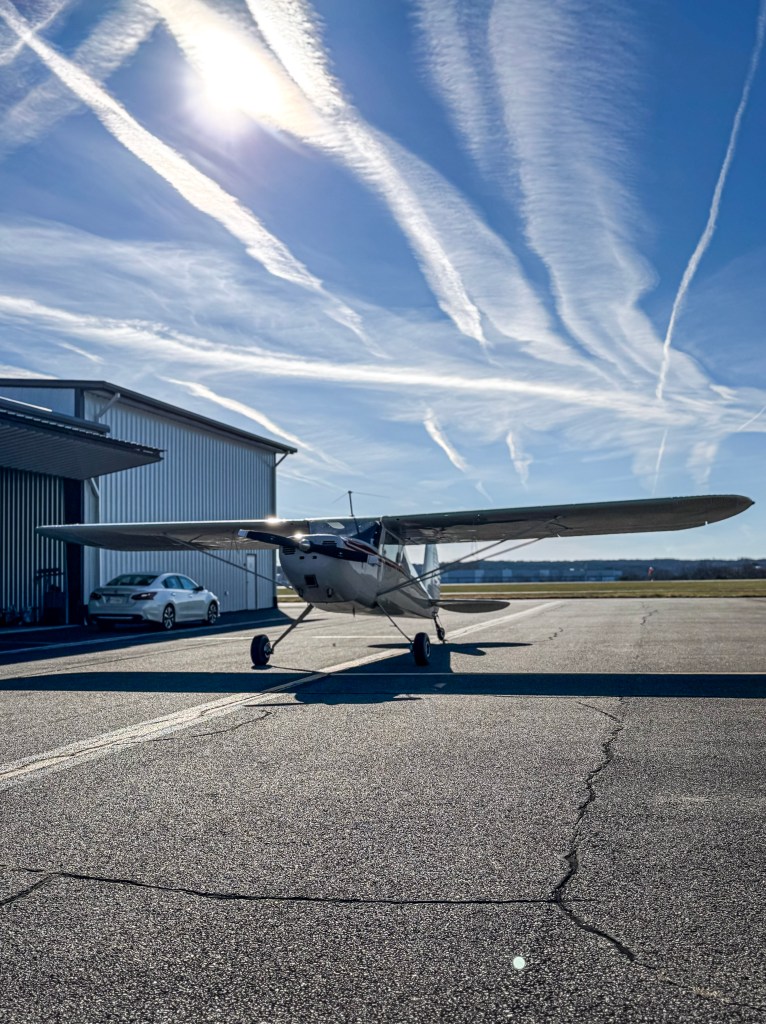
It was a warm day in early fall—the kind where summer hasn’t quite let go of its grip on the stifling air, but the breeze hints at autumn’s embrace. I walked onto the airport with nervous anticipation: I’d be stacking a few firsts in one flight. First time flying the airplane I hoped to buy. First time in a tailwheel. And, as it turned out, my first taste of backcountry flying and grass strips.
I slid up to the hangar and there she was, already pulled out and ready. My guide for the day—let’s call him T‑Money to protect the innocent—was waiting with that calm, confident energy you want in the right seat. After a thorough preflight and a quick brief, we strapped in, started up, and taxied out. To my surprise, he had me doing most of the work: taxi, run‑up, and a takeoff with coaching and close supervision.
Once clear of the pattern, we wandered over the countryside at a comfortable sightseeing altitude, cruising around 100 mph / 90 knots—slow enough to take it all in, fast enough to feel like we were going somewhere. This was no Mooney, and that was the point. Climbing in the cockpit, the airplane had that familiar “warbird-in-a-museum” smell that took me right back to childhood. And with no glass panel to hide behind, you fly with your eyes, ears, and hands. There’s something refreshingly honest about a no‑frills airplane like this: keep the skylights pointed at blue, not brown.
A few miles from the airport, T‑Money had us slow down and set up for the strip. We made a reconnaissance pass to spot the windsock, check the surface, and talk through the approach. “Are you ready for this?” he asked. I laughed—half nerves, half excitement—and said, “As long as you’ve got me, man.”
On the next pass he demonstrated the sight picture and energy management that makes grass‑strip landings feel so different. A forward slip, a stabilized flare, and then—light tires on turf. The airplane bounced a bit on the softer surface (a good reminder that grass talks back), and then it was power in, climb out, and a smooth turn back toward open air. “That’s money, baby!” he said… allegedly.
By the time we’d visited a couple more strips—including one full stop—I was hooked. I’d touched grass and seen the light. We even did a quick handling demo over open farmland to show just how steady and confidence‑inspiring the airplane felt.
Back on solid ground I told my buddy, “We have to do this—we have to incorporate grass‑strip operations in our business model.” For a few reasons:
- It’s fun, full stop. Most pilots never land on grass during primary training, so the first few times feel unfamiliar—in the best way. It’s also a genuine skill‑builder that will test your feet, your sight picture, and your judgment. Flying is fun, and it’s ok to remind ourselves from time-to-time to enjoy it and do things that thrill us.
- In most training you’ll *talk* about off‑airport options, but you rarely practice the planning, surface considerations, and sight picture that make it work. We hope necessity never becomes reality, but having experienced turf in a controlled environment makes you calmer and more capable if the day ever comes.
- This is as close to the early days of flight as many of us will ever get. Before LED screens and digital maps (I’m not hating—I still use ForeFlight religiously), those pioneers had little more than their eyes and ears. Grass strips keep you honest: you’re looking outside, flying with your hands and feet, and staying ahead of the airplane. It’s raw, real flying—and it will keep your senses sharp.
Even though I didn’t end up making aviation my career, the kid in me still lights up when the flying gets simple and hands‑on. As a kid, I pictured low‑and‑slow turns, looking outside, feeling the wind and the airplane, and being fully present. I idolized the Bud Andersons and Chuck Yeagers of the world, even though I knew the golden age of aviation had already passed and I might never touch a P‑51, a B‑17, an F4U, or any of the machines I grew up idolizing.
But grass strips get me closer than I expected—not because they’re “extreme,” but because they demand the same things that made flying magical in the first place: judgment, discipline, and a little bit of humility. No hiding behind screens. Just real flying.This is what we want to share at Virginia Tailwheel Academy: a safe, structured way to learn tailwheel fundamentals, build confidence on turf, and swap a few good hangar stories along the way. If you grew up on asphalt runways (and maybe the magenta line), come see what you’ve been missing.
Want updates on training dates, availability, and new stories? Subscribe to our newsletter. Or reach out to schedule an intro flight—we’d love to meet you.
-Steven-
 Virginia Tailwheel Academy
Leave a comment